
Approximate read time: 7-8 minutes
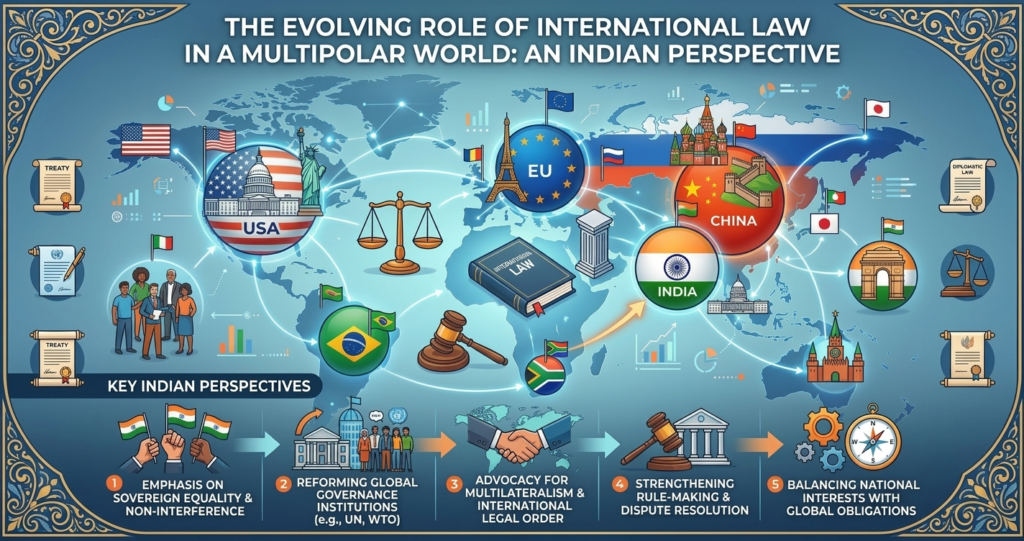
In recent decades, the international order has witnessed a profound shift. The once-dominant unipolar world, defined by Western influence and U.S.-centric institutions, is gradually paving the way towards a more complex, multipolar system. Emerging powers like India, China, Brazil, South Africa, and others are reshaping how nations engage with global governance, diplomacy, and international law. Among these, India stands out as a democracy that bridges the developed and developing worlds, offering a distinctive voice rooted in both pragmatism and principle.
International law was largely conceived in the aftermath of global conflicts, with the intent of promoting peace, cooperation, and shared norms. Yet, as global power becomes more diffused, its very foundations are being tested. New centres of influence are emerging, and with them come competing ideas about sovereignty, security, and justice.
In this evolving landscape, questions arise: Who sets the rules? Who enforces them? And how can international law remain relevant when nations increasingly assert their own priorities over collective norms?
India’s growing role in this debate is particularly significant. As a country deeply committed to sovereignty and democratic governance, yet actively engaged in multilateral institutions, India embodies the challenges and opportunities of a multipolar world order.
India’s engagement with international law is deeply intertwined with its post-independence identity. At the time of its founding, India adopted a foreign policy of non-alignment — not as isolationism, but as a moral stance rooted in autonomy and fairness. Leaders like Jawaharlal Nehru viewed international law as a means to promote global justice, equality among states, and peaceful coexistence.
Over time, however, India’s approach matured. From being a “rule-taker” in the early decades to becoming a “rule-shaper” in the 21st century, India has steadily expanded its influence in forums such as the United Nations, the World Trade Organization, and the International Court of Justice. Its participation reflects a blend of legal idealism and strategic realism promoting equity without compromising national interest.
Multipolarity and the Rebalancing of Global Norms
A multipolar world naturally diffuses authority. Instead of a single dominant voice, multiple powers now participate in norm creation and enforcement. This shift challenges the traditional Western-centric frameworks that long defined “universal” law.
For India, this rebalancing presents both responsibility and opportunity.
India has already begun to influence discourse in areas such as climate justice, digital governance, and maritime law. Its advocacy for the “Common but Differentiated Responsibilities” principle in climate negotiations, for instance, reflects an insistence on fairness between developed and developing nations, a cornerstone of India’s international legal philosophy.
For international law to thrive in a multipolar era, it must evolve beyond dominance-based structures. India’s role in this evolution will depend on its ability to lead through example blending its civilizational ethos with pragmatic diplomacy.
India’s growing influence in groupings like BRICS, the G20, and the QUAD illustrates that leadership today requires dialogue, diversity, and adaptability.
Whether addressing global trade inequities, climate transitions, or digital governance, India’s approach remains guided by the belief that international law should not be an instrument of power, but a framework for fairness.
As the world transitions toward multipolarity, international law is being redefined, not discarded. The challenge lies in ensuring that this new order remains rules-based, inclusive, and humane.
India’s voice in this transformation carries moral weight. Rooted in ancient ideals of Vasudhaiva Kutumbakam “the world is one family” and informed by contemporary legal sophistication, India stands poised to help craft a new kind of international law: one that reflects diversity without disorder, and power with responsibility.
In the coming decades, the effectiveness of global governance will depend on whether nations can collaborate without conformity. India’s evolving role offers hope that balance between justice and sovereignty, between national interest and global good remains possible in our interconnected world.