
A Comprehensive Legal Guide for NRIs Facing Family Matters Overseas

Approximate read time: 10-11 minutes
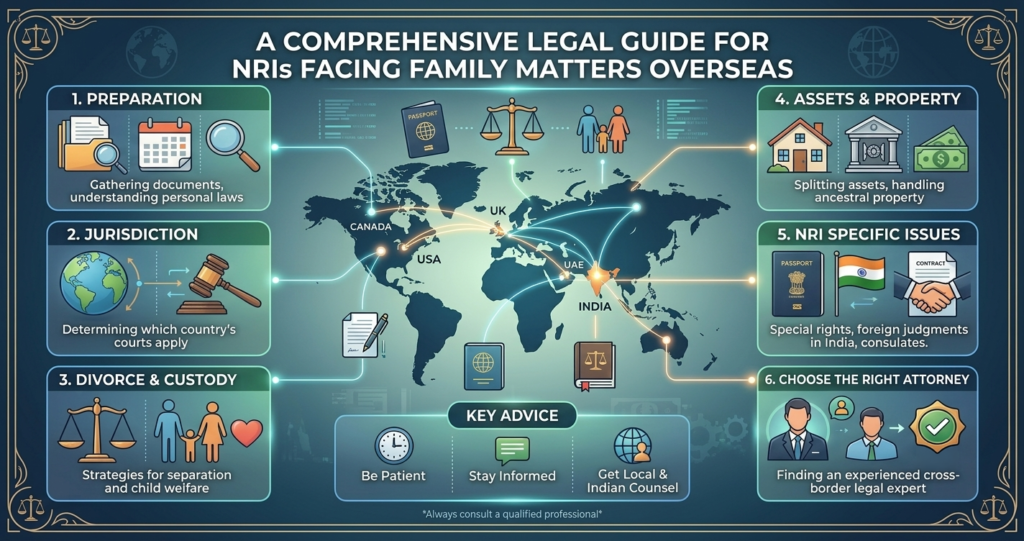
A Comprehensive Legal Guide for NRIs Facing Family Matters Overseas

Family disputes are challenging in the best of circumstances. But for Indian passport holders living abroad, these issues become significantly more complex due to differences in legal systems, jurisdictional conflicts, and the emotional difficulty of handling matters across two countries.

Whether you are in Australia, Canada, the UK, the USA, the Middle East, or Southeast Asia, the questions many Indians face are strikingly similar:

This comprehensive guide breaks down everything Indian passport holders, NRIs, and OCI cardholders need to know when navigating family matters in a foreign country, especially when Indian and overseas legal systems overlap.

1. Understanding the Cross-Border Context

Indian Passport Holders vs NRIs vs OCI Cardholders

While these terms are often used interchangeably, they carry different legal consequences:

  • Indian Passport Holder: Citizen of India, regardless of residence.
  • NRI (Non-Resident Indian): Indian citizen residing abroad for work, study, or long-term stay.
  • OCI Cardholder: A foreign national of Indian origin, not an Indian citizen.

In family law disputes, the distinction matters because:

  • Indian laws continue to apply to Indian citizens.
  • Certain foreign family court orders may not be automatically valid in India.
  • Jurisdictional challenges depend on citizenship, domicile, and place of marriage.

This is why cross-border family law requires a strategy that factors in both Indian and foreign legal systems.

2. Cross-Border Divorce: Where Should Indian Passport Holders File?

One of the most commonly searched topics among NRIs is:

“Can I get divorced overseas if I got married in India?”

Foreign Divorce Recognition in India

An overseas divorce decree is recognised in India only if:

  • Both spouses voluntarily submitted to the jurisdiction of the foreign court, and
  • The divorce was granted on a ground accepted under Indian matrimonial law.

For example:

  • A mutual consent divorce in Australia can be recognised in India when both parties participate.
  • An ex parte divorce abroad (decided without your presence) is usually not valid in India.
  • A divorce granted purely on foreign grounds (like Australia’s “irretrievable breakdown”) may be rejected in India.

This creates situations where a person is divorced abroad but still married under Indian law, leading to complications in remarriage, property rights, and legal responsibilities.

3.  Child Custody and Relocation Disputes Overseas

Child custody becomes significantly more complex when parents live in different countries.

India and the Hague Convention

India is not a signatory to the Hague Convention on International Child Abduction, which means:

  • Foreign “return orders” may not be automatically enforced in India.
  • Indian courts prioritise the child’s “welfare and best interests,” not habitual residence alone.
  • Parents often face prolonged, multi-jurisdictional custody battles.

When Children Are Taken to India or Overseas

Common issues include:

  • One parent relocating to India with the child.
  • Travel restrictions imposed by foreign courts.
  • Passports being withheld until custody issues are resolved.
  • Conflicting custody orders between India and the foreign country.


Indian courts analyse:

  • Safety and welfare of the child.
  • The child’s emotional and educational environment.
  • Allegations of domestic violence or coercion.
  • Whether relocation benefits the child.


Foreign courts look at:

  • Habitual residence.
  • Stability and routine of the child.
  • Parenting capacity and financial ability.
  • Immigration status.


Indian passport holders must approach custody cases strategically, ensuring both jurisdictions are handled in a coordinated manner.

5. Domestic Violence: Protection for Indian Passport Holders Overseas

Financial support laws differ widely between India and foreign jurisdictions.

In India:

  • Maintenance under Section 125 CrPC
  • Alimony under personal laws (Hindu, Muslim, Christian, Parsi, etc.)
  • Evidence of financial dependency required
  • Enforcement through warrants, attachment, etc.

In Countries like Australia, Canada, the UK, and the US:

  • Spousal support based on “capacity to pay” and “financial needs.”
  • Mandatory financial disclosures
  • Faster enforcement mechanisms
  • Child support calculated through statutory formulas
  • Strong penalties for non-payment


For Indian passport holders, the challenge is that orders in one country may affect the other.
A carefully planned cross-border financial strategy prevents duplication, non-compliance, or contradictory orders.

5. Domestic Violence: Protection for Indian Passport Holders Overseas

Domestic violence laws in foreign countries are robust, and Indian citizens are fully protected under local legislation.

Protections Abroad May Include

  • AVOs (Apprehended Violence Orders) in Australia
  • Non-Molestation Orders in the UK
  • Restraining Orders in the US
  • Protection Orders in Canada and the EU

These orders cover:

  • Physical harm
  • Emotional and
  • psychological abuse
  • Coercive control
  • Financial abuse
  • Immigration-related manipulation
  • Digital harassment

Indian Domestic Violence Protections Still Apply

Indian citizens can also seek relief under:

  • The Protection of Women from Domestic Violence Act, 2005
  • Section 498A IPC
  • Dowry Prohibition Act
  • Right to residence and maintenance

Are foreign DV orders valid in India?

In many cases, yes — Indian courts may consider foreign protection orders under:

  • Comity of courts
  • Urgency
  • Safety concerns

However, execution is not automatic. A cross-border approach is essential.

Enforceability of Indian Court Orders Overseas:

Indian orders are not always directly enforceable abroad.

When Foreign Countries Accept Indian Judgments?

Under Section 44A CPC, India has “reciprocating territories” such as:

  • UK
  • Singapore
  • UAE
  • Malaysia
  • Hong Kong

In these countries, Indian civil decrees can be enforced more easily.

What about Australia?

Australia is not a reciprocating territory.

This means:

  • Indian decrees must be filed afresh and converted into local orders.
  • Enforcement is possible but requires legal steps overseas.
  • Family orders must go through judicial assessment.

6. Litigating in India While Living Abroad Conclusion

Indian passport holders do not always need to travel home for family cases.

Indian courts today allow:

  • Virtual hearings
  • Filing through Power of Attorney
  • Digital submission of affidavits and evidence
  • Cross-examination through video link
  • Email service of notices in many cases

This makes it easier for NRIs to pursue:

  • Divorce
  • Custody
  • Maintenance
  • Domestic violence cases
  • Execution of orders
  • Property disputes related to marriage

7. Mutual Consent Divorce for NRIs and Overseas Indians

One of the most efficient cross-border remedies is mutual consent divorce.

It can be completed when:

  • Both spouses live abroad
  • One spouse lives in India and the other overseas
  • Both parties agree on terms
  • Video conferencing is allowed
  • POA attestation is done via the Indian consulate

This is the most practical route for Indian citizens seeking a peaceful resolution abroad.

8.  Role of Indian Embassies and Consulates

Indian consulates cannot intervene in private disputes, but they do assist with:

  • Attestation of documents
  • Power of Attorney authentication
  • Emergency support
  • Guidance during custody or welfare concerns
  • Passport renewals and child passport objections
  • Connecting citizens with legal counsel

9. How IndoPacta Legal Assists Indian Passport Holders Overseas

As a boutique firm specialising in cross-border India–Australia family matters, IndoPacta Legal provides:

  • Strategic cross-jurisdictional advice
  • Coordinated proceedings in India and overseas
  • Drafting, filing, and representation for Indian courts
  • NRI divorce and custody planning
  • Assistance with foreign judgment enforcement
  • Virtual representation for NRIs
  • Documentation support through consulates
  • Complete confidentiality and personalised legal care

Our approach ensures that your rights are protected in both jurisdictions, without unnecessary travel, delays, or conflicting court orders.

Conclusion

Family matters are sensitive, emotional, and legally complex — even more so when they involve two or more countries. For Indian passport holders and NRIs, navigating unfamiliar legal systems alongside Indian personal laws can feel overwhelming.

This guide aims to provide clarity, direction, and reassurance. No matter where you live, your legal identity, rights, and protections as an Indian citizen continue to follow you across borders.

At IndoPacta Legal, we are committed to helping you:

  • Understand your legal position
  • Choose the right jurisdiction
  • Protect your family and financial rights
  • Simplify cross-border proceedings
  • Avoid contradictory or unenforceable judgments
  • Achieve practical, workable solutions that bring peace and certainty

Wherever you are in the world, you don’t have to face these challenges alone. IndoPacta Legal will always be with you in every step.