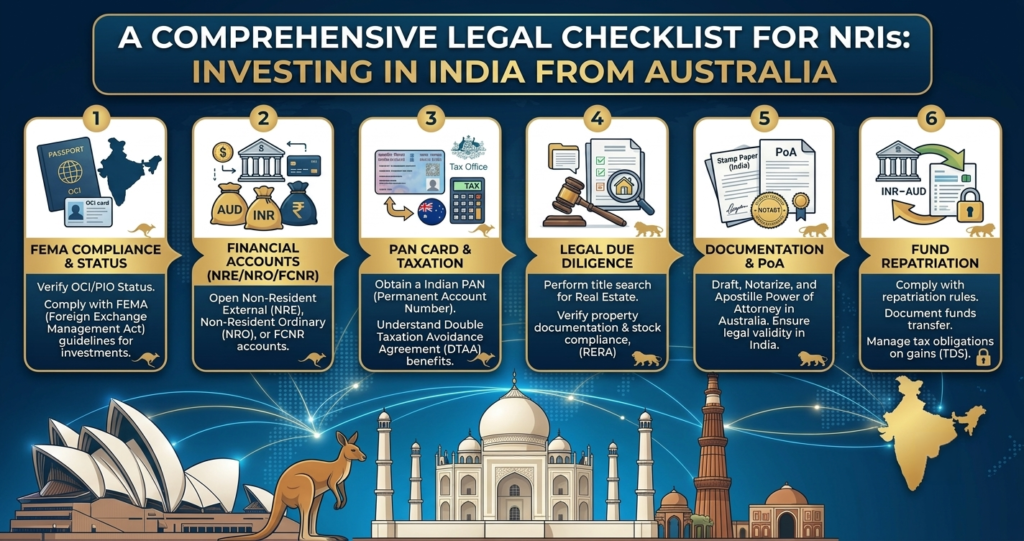
1. Understand Your Legal Status as an NRI
Indian Passport Holders vs NRIs vs OCI Cardholders
Before making any investment, it is crucial to determine your status under Indian law:
- As per the Foreign Exchange Management Act, 1999 (FEMA), an NRI is a person residing outside India for employment, business, or other purposes.
- Your NRI status determines:
– Type of investments allowed
– Tax obligations
– Repatriation rules
2. Property Investment in India: Key Legal Considerations
Real estate remains one of the most popular investment avenues for NRIs.
What NRIs CAN buy:
- Residential properties
- Commercial properties
What NRIs CANNOT buy:
- Agricultural land
- Plantation property
- Farmhouses (with limited exceptions)
Legal Checks:
- Verify clear title ownership
- Check for encumbrances Ensure RERA
- registration (if applicable)
- Review builder agreements carefully
3. Power of Attorney (PoA): A Practical Necessity
Since you are residing in Australia, executing transactions remotely is common.
- A Power of Attorney (PoA) allows a trusted individual in India to act on your behalf.
- Must be:
– Properly drafted
– Notarised/attested in Australia
– Adjudicated/stamped in India
Poorly drafted PoAs are one of the biggest legal risks NRIs face.
4. FEMA & RBI Compliance
All NRI investments must comply with regulations under:
- Reserve Bank of India (RBI)
- FEMA guidelines
Key Rules:
- Transactions must be routed through:
– NRE (Non-Resident External) accounts
– NRO (Non-Resident Ordinary) accounts - Restrictions on repatriation apply depending on account type
5. Taxation: India + Australia Implications
Cross-border taxation is one of the most overlooked aspects.
In India:
- Rental income is taxable
- Capital gains tax applies on sale
In Australia:
- Global income may be taxable depending on residency
Relief Mechanism:
- The India–Australia Double Taxation Avoidance Agreement (DTAA) helps avoid double taxation
Proper structuring can significantly reduce your tax burden.
6. Due Diligence Checklist (Must Follow)
Before investing, ensure:
- Title verification from a legal expert
- Background check of seller/builder
- Review of all contracts and agreements
- Local compliance (state-specific laws in India)
- Bank transaction traceability
7. Common Risks NRIs Must Avoid
- Investing without legal verification
- Relying solely on relatives or brokers
- Signing incomplete or vague agreements
- Ignoring tax implications
- Using informal payment channels
8. Why Legal Guidance is Essential
Cross-border investments are not just financial decisions, they are legal commitments across jurisdictions.
A qualified legal consultant can help you:
- Draft and review contracts
- Ensure FEMA compliance
- Structure tax-efficient investments
- Represent your interests in India
Conclusion
Investing in India from Australia offers excellent opportunities—but only when approached with proper legal planning and compliance. By following this checklist, NRIs can minimise risks and maximise returns while staying legally protected.
Need Assistance?
At IndoPacta Legal, we specialise in cross-border legal advisory for NRIs, helping you invest in India with confidence and clarity. Visit our website www.indopactalegal.com and book your consultation today.